
Are ZYNs bad for your gums?

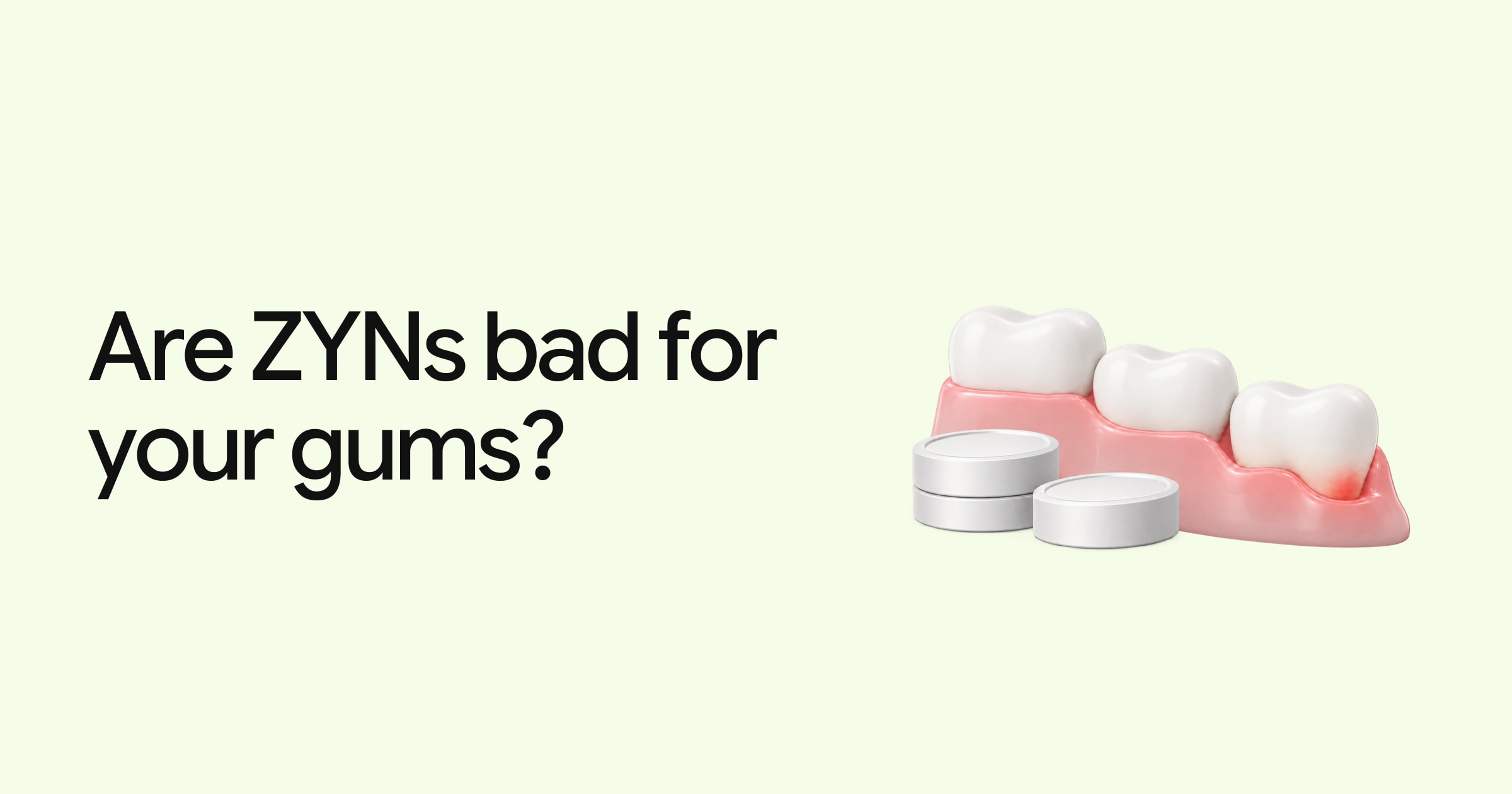
Yes, ZYN pouches can be bad for your gums, mostly in the spot where you keep the pouch. Studies of nicotine pouch users keep finding irritation, white patches and, in some people, gum recession right where the pouch sits. Most of these changes are local, and the irritation usually settles once the pouch is gone. Whether ZYN causes gum disease or gum cancer over the long run, nobody knows yet: the products are too new and the studies are small.
This applies to nicotine pouches in general, not just ZYN. Most studies don't separate brands, and the ingredients are similar across them.
What ZYN can do to your gums
A ZYN pouch sits in one place, pressed between your lip and gum, for up to 30 minutes at a time (ZYN), and heavy users repeat that 10 or 15 times a day, often in the same spot. Researchers suspect three things: pressure from a firm pouch in one spot, alkaline pH adjusters that help nicotine absorb through the gum, and nicotine narrowing blood vessels in that tissue. None of these has been proven to drive the damage.
What ZYN gum damage looks like
Nicotine pouch gum damage tends to show up where you place the pouch. A 2024 systematic review and the studies since then describe:
- Redness and soreness. Inflamed, tender gum or inner lip. In a 2026 Swedish study of 18 to 30 year olds, nicotine pouch users had more redness and more symptoms than snus users.
- White or wrinkled patches. The tissue thickens where the pouch rubs, from slight wrinkling to a clearly white area. In a Latvian case series, all five pouch users who were examined had white lesions at the placement site, and biopsies showed thickened, inflamed tissue.
- Small cuts, blisters or ulcers. Sore spots that sting with mint or acidic food.
- Gum recession and sensitivity. The gum line pulls back and the tooth looks longer than its neighbors. Once the root is exposed, the tooth often hurts with cold drinks.
In that Swedish study, 79% of nicotine pouch users had some kind of oral lesion.
Show it to a dentist if: a sore, ulcer or white or red patch hasn't healed two to three weeks after you stop putting a pouch there; the gum over one tooth is visibly lower than over the others; a patch is hard, raised or bleeds easily; or a tooth near your pouch spot has become sensitive. Tell them you use pouches and where you put them.
Do ZYNs cause gum recession?
Gum recession has been documented in ZYN and other nicotine pouch users at the pouch spot, in a few studies from 2025 and 2026. What isn't proven yet is how often it happens or how much of it is caused by the pouch rather than by brushing, gum shape or past smoking.
Two 2025 case reports describe healthy men in their twenties who developed recession exactly at the pouch spot after 11 and 18 months of daily use. In a 2026 study of firefighters, Chaffee and colleagues gave full gum exams to 12 pouch users and 14 people who didn't use any nicotine. The pouch users had more sites where the gum had lost its attachment to the tooth: 16.5% vs 5.3%.
So the signal is consistent but the evidence is thin: case reports and one small cross-sectional study, neither of which can prove cause and effect. The older research on snus, which is also held under the lip, points the same way. In a Norwegian study of 216 daily snus users aged 18 to 20, 18% already had gum recession, and the odds went up by 34% for each year of use. Snus contains tobacco and pouches don't, so this is context, not proof about ZYN.
If you use pouches daily in the same spot, ask your dentist to check it at your next visit.
ZYN gum recession vs gum disease
- Gum recession means the gum line moves down and exposes part of the tooth root. With pouches it is usually local: one or two teeth, right where the pouch sits, in a mouth that's otherwise healthy.
- Gum disease (periodontal disease) is an inflammatory disease driven by plaque bacteria that tends to affect several areas of the mouth, not just one spot: gums that bleed when you brush and, in later stages, loss of the bone holding the teeth.
Gum disease can cause recession, but recession from a pouch doesn't mean you have gum disease.
Do ZYNs cause gum disease?
So far there's no clear evidence that ZYN or other nicotine pouches cause gum disease. The Swedish study of 126 young pouch users found no increased risk of periodontal disease with up to six years of use. The firefighters study saw more attachment loss and shifts in the mouth's bacteria in pouch users, which the authors called early signals worth following up. Long-term snus users have more gingivitis but no clear increase in periodontitis (Bankvall and Jontell, 2026).
Do ZYNs cause gum cancer?
There's no evidence that ZYN or other nicotine pouches cause gum or oral cancer, and also not enough evidence to say they don't.
A 2026 review on nicotine pouches and oral cancer found that "no long-term epidemiological evidence is currently available." Oral cancer takes many years to develop, and nicotine pouches have been widely sold for less than a decade. The human studies that exist are few and small.
When the FDA authorized 20 ZYN products in January 2025, it said they contain substantially lower levels of harmful constituents than cigarettes and most smokeless tobacco, and therefore pose a lower risk of cancer than those products. It also said the authorization "does not mean these tobacco products are safe" (FDA).
The tissue under the pouch does change, though. Biopsies of white patches in pouch users show thickened, chronically inflamed tissue (Miluna-Meldere et al., 2024). That isn't cancer, and nobody has shown it turns into cancer. But a white patch that doesn't go away should be checked by a dentist, and the authors of the 2025 case reports recommended a biopsy for that reason.
Swedish snus, studied for decades, hasn't shown a clear link with oral cancer in large studies, according to the same 2026 review.
Can your gums heal after stopping ZYN?
Partly, depending on the kind of damage.
- Irritation, redness, sores and white patches usually heal. Research on snus has shown for decades that these lesions regress quickly once the pouch is gone or moved somewhere else (Kallischnigg et al., 2008).
- Gum recession doesn't grow back on its own. Stopping removes the ongoing pouch exposure, but existing recession usually stays. In a small 2025 pilot, users who switched to a pouch with a barrier against the gum reported less irritation within five weeks but no change in recession. If recession is causing sensitivity or bothers you, a dentist or periodontist can talk you through options like a gum graft.
Many of the irritation changes improve, but recession usually doesn't, and it can keep adding up for as long as the pouch stays in the same spot. That's a good reason to cut down sooner rather than later.
If you're ready to stop, start with how to quit ZYN nicotine pouches, and see what ZYN withdrawal feels like so the first week doesn't catch you off guard.
How to reduce gum exposure if you keep using pouches
If you're not ready to quit yet, you can still put less strain on your gums. None of this makes pouches safe. Less contact should mean less local irritation, though no study has tested whether it prevents recession.
- Cut contact time. Use fewer pouches a day and take each one out sooner. Going from 12 pouches a day to 6, or taking them out after 15 minutes instead of 30, halves the time your gums spend under a pouch.
- Give your gums breaks. Don't keep one in all day, and don't sleep with a pouch in.
- Move it around. Switch between the left and right side, and between upper and lower lip. Snus lesions heal when the pouch is moved elsewhere, so rotating gives each spot time to recover.
- Check your pouch spot. Look at it in the mirror once a month for white patches, sores that don't heal and gum that's pulling back, and ask your dentist to measure the gum there so you have a baseline.
Cutting down works better when you can see what you're actually using. That's why we built ExPouch: you log each pouch in one tap, see your pouches and milligrams per day, and follow a plan that lowers your daily target step by step.
Frequently asked questions
Are caffeine pouches bad for your gums?
There are no studies on caffeine pouches and gum health yet. They don't contain nicotine, so one suspected mechanism, reduced blood flow from nicotine, is missing. But they still create prolonged contact and pressure at the placement site. The same habits that reduce gum exposure apply.
Do caffeine pouches cause gum recession?
Nobody has studied it. With heavy use in one spot it's possible, but there's no evidence yet either way.
Is ZYN worse for your gums than cigarettes?
Not overall. Smoking doubles the risk of gum disease (CDC) and is a major cause of oral cancer, while pouches haven't been shown to cause either. Pouches do cause more local damage at the placement spot. In a 24-week randomized trial of 155 smokers, those who switched to on! pouches had less gum inflammation and bleeding than those who kept smoking. The trial used on!, not ZYN, and was run by on!'s maker, Altria. The best option for your gums is to use neither.
Is ZYN worse for your gums than snus?
They seem to do different kinds of local damage. In the 2026 Swedish study, lesions were slightly less common in nicotine pouch users than in snus users (79% vs 89%), but pouch users had more redness and more symptoms, while snus users had more thickened white tissue. Recession has been documented with both. Snus also contains tobacco-specific carcinogens that pouches have at much lower levels.
Sources
- Alkhatib OA. Localized gingival recession and leukoplakia associated with nicotine pouch use: two clinical case reports. BMC Oral Health, 2025.
- Bankvall M, Jontell M. Swedish smokeless tobacco and its impact on oral health: a systematic review. Acta Odontologica Scandinavica, 2026.
- CDC. Smoking, gum disease, and tooth loss.
- Chaffee BW, et al. Oral nicotine pouch use and associations with periodontal status and salivary microbiome dysbiosis. JDR Clinical & Translational Research, 2026.
- Daneshian M, et al. Oral lesions and dental status in individuals using oral tobacco-free nicotine pouches. Oral Diseases, 2026.
- FDA. FDA authorizes marketing of 20 ZYN nicotine pouch products after extensive scientific review. 2025.
- Kallischnigg G, et al. Systematic review of the relation between smokeless tobacco and non-neoplastic oral diseases in Europe and the United States. BMC Oral Health, 2008.
- Kopperud SE, et al. Oral lesions associated with daily use of snus, a moist smokeless tobacco product: a cross-sectional study among Norwegian adolescents. Acta Odontologica Scandinavica, 2023.
- La Rosa GRM, et al. Nicotine pouches, oral cancer and tobacco harm reduction: current evidence and research priorities. Frontiers in Oral Health, 2026.
- La Rosa GRM, et al. Self-reported oral health outcomes after switching to a novel nicotine pouch technology: a pilot study. Acta Odontologica Scandinavica, 2025.
- Liu J, et al. Oral health effects among adults switching from cigarettes to on! nicotine pouches compared to those who continue smoking. Oral Health & Preventive Dentistry, 2025.
- Miluna-Meldere S, et al. Oral mucosal changes caused by nicotine pouches: case series. Diagnostic Pathology, 2024.
- Rungraungrayabkul D, et al. What is the impact of nicotine pouches on oral health: a systematic review. BMC Oral Health, 2024.
- ZYN. How long do nicotine pouches last?